

What the dance language of bees really has in common with human language
Bees communicate information about food sources using a sophisticated "dance language". Linguists used to doubt that it bears any interesting relation to human language, but new research suggests that it shares detailed properties with certain constructions of sign languages, called "classifiers—a remarkable case of convergence given that the last common ancestor of bees and humans lived 600 million years go.
Eight decades ago, the Austrian ethologist (and 1973 Nobel Prize winner) Karl von Frisch showed that bees communicate detailed information about food sources using a “dance language”. After finding food, a bee that returns to its hive can start waggling its body while crawling in an 8-like shape, as shown in Fig. 1.
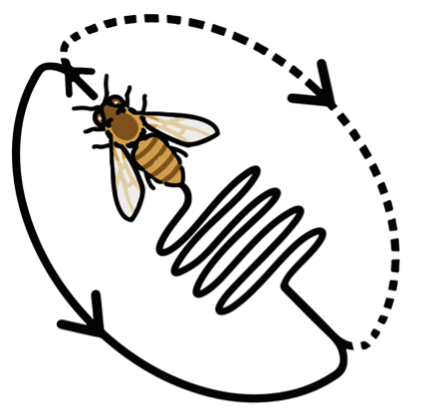
In the waggle dance, the bee waggles its body while crawling forward, before returning to its starting point without waggling, alternately on one side or on the other.
Credits: https://commons.wikimedia.org/wiki/File%3A202208_European_honey_bee_waggle_dance.svg?utm_source=chatgpt.com
The waggling phase provides three types of information about the food. The direction encodes that of the food location. The duration indicates how far the location is, with a code that is so precise that researchers can time the waggling phase to calculate food distance (the longer the phase, the further the food). And the number of repetitions of the waggle run provides information about food quality (the more runs, the better).
The dance is not uniform among bee species, however. Some have horizontal hives and correspondingly dance horizontally, with the waggling phase pointing towards the food source. Others have vertical hives and dance vertically. In such cases, the food direction is encoded with transposition, in the following sense: an upwards vertical movement means that the food is in the direction of the sun; and any angle of the dance relative to the vertical means that the food direction is at the same angle relative to the direction of the sun, as illustrated in Fig. 2.
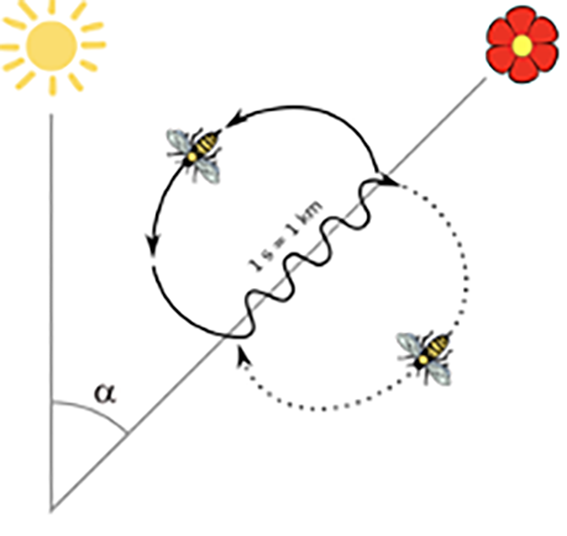
The angle of the waggle run relative to gravity is interpreted as the angle of the food direction relative to the direction of the sun. The duration of the waggle run is interpreted in terms of distance, here with 1 s corresponding to 1 km.
Credits: https://commons.wikimedia.org/wiki/File:Bee_dance.svg
To this day, the waggle dance counts as one of the most sophisticated systems of non-human communication ever found in nature. But does it have any interesting properties in common with human language? Von Frisch thought so, hence his use of the term “dance language”. Linguists have generally been unconvinced. First, in 1953 the great French linguist Emile Benveniste commented (wrongly, as we will see) that "there can be no real language without the exercise of voice". Second, Benveniste as well as several later linguists (including the great American linguist Noam Chomsky) objected that human language is based on discrete words and morphemes that are sharply distinct from each other, not on a continuous system in which one expression can be gradually turned into another—precisely what happens with the waggle dance, where dance direction and duration can be gradually modified.
But are these objections correct? Regarding the first one, Benveniste’s pronouncement was shown to be spectacularly wrong when linguists investigated sign languages (used by Deaf communities around the world). They do not use “voice” but are full-fledged languages with the same general grammatical and expressive properties as spoken languages. It is thus undeniable that there can be language without voice. The second objection, pertaining to the distinction between discrete and gradient systems, is only partly correct. It is true that spoken and sign languages alike are based on discrete words and morphemes. But when one digs deeper, sign languages also have designated constructions, called classifiers, which undoubtedly have a gradient component. While the form (manual shape) of classifiers is fixed, just as for any other word, their position and their movement can be gradiently modified, and they are interpreted iconically (i.e. depictively), as simplified visual animations1. For instance, in ASL (American Sign Language), two upright fingers moving can represent a person moving, towards the right or towards the left depending on the fingers’ movement, fast or slow depending on the fingers’ speed, etc.
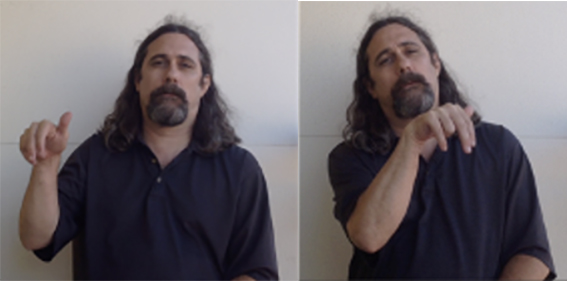
There are multiple classifiers across sign languages. Two further examples from ASL are the small animal classifier (which could for instance represent a bee), shown in Figure 4a, and the helicopter classifier, shown in Figure 4b.
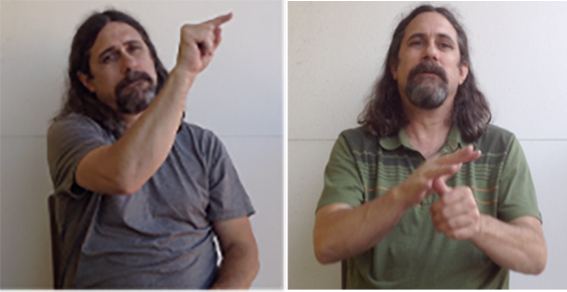
Left : a. A small animal classifier
Right : b. A helicopter classifier
With a multidisciplinary team that includes two Deaf native signers of ASL (Jonathan and Jason Lamberton) and a specialist of bee behavior (Christoph Grüter), Philippe Schlenker (CNRS)2, and Emmanuel Chemla (CNRS and Earth Species Project)3 show in a new study that ASL classifiers share three key properties of the waggle dance. First, the direction of the small animal classifier shown in Fig. 4a can represent the direction of the animal’s movement, just like the direction of the waggle dance represents the direction of movement towards the food. Second, the duration of the classifier’s movement can represent how long and thus how far the animal moved, just like the duration the waggle dance encodes food distance. Third, depending on the context, the classifier movement can directly display the direction of the animal's movement, or it can be interpreted with transposition. For instance, if a signer recounts what happened yesterday when Ann released a bee that went out flying, the classifier’s movement will be interpreted from Ann’s viewpoint as she was observing the scene (= interpretation with transposition), not from the signer's current viewpoint. So if the classifier goes towards the signer’s left, this means that the bee went towards Ann’s left, as shown in Fig. 5.
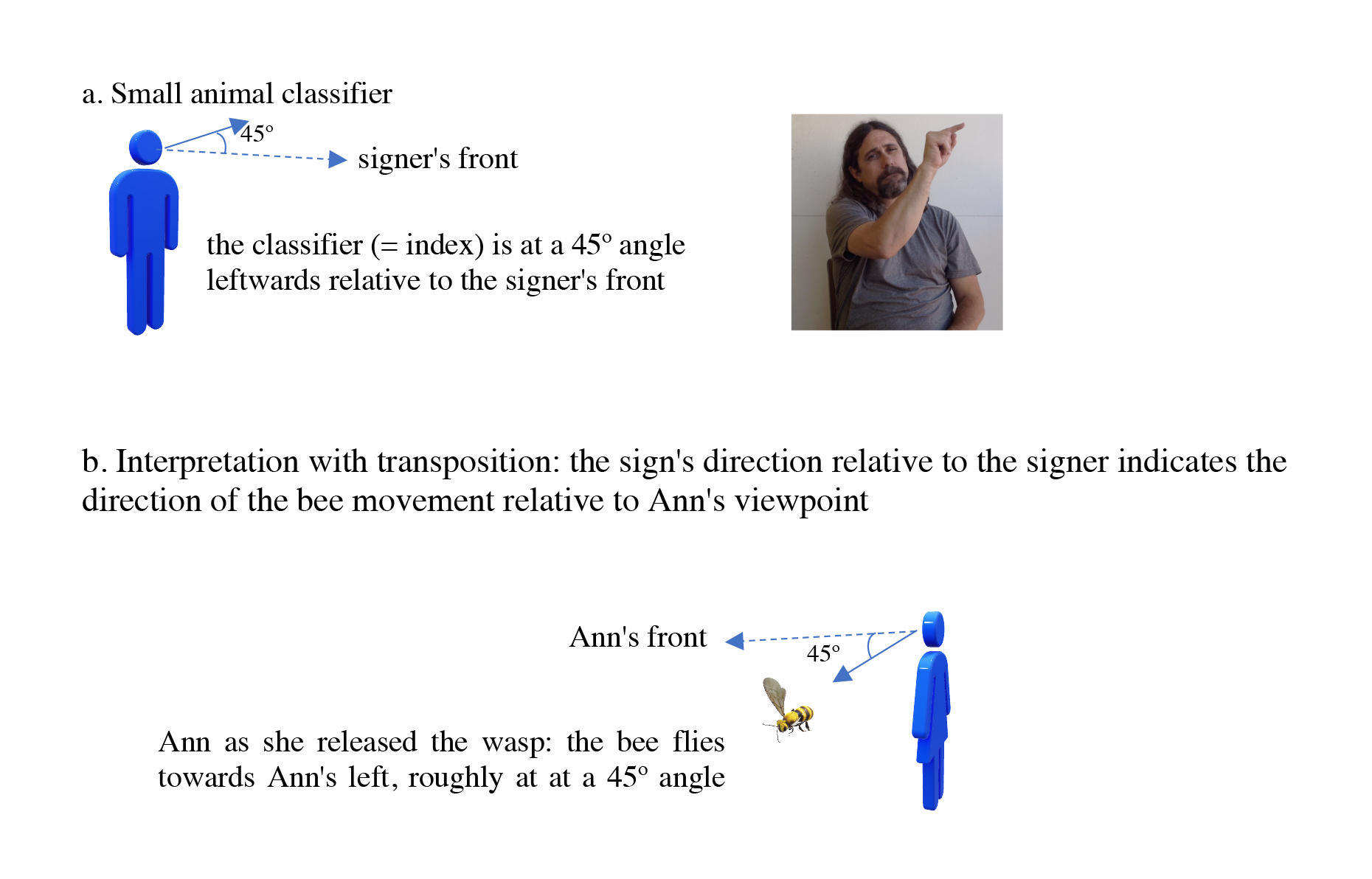
In the context, Ann released a bee yesterday. The signer recounts this with a classifier moving towards his left at a 45º angle. This is interpreted with transposition from Ann’s viewpoint as she was releasing the bee: the bee flew out towards Ann’s left at a 45º angle.
Thus three key properties of the waggle dance can be found in sign language classifiers: the interpretation of direction and duration, and the existence of transposition. But what about the last property, namely repetition—the fact that more waggle runs indicate better food quality? It is similar to a general property of human language (and probably many animal communication systems), where repetition can convey intensification. “I am rich, rich, rich!” conveys greater richness than just “I am rich”, and similarly “Go! go! go!” serves to highlight the urgency of an order. Such effects can be found in sign language as well, including with classifiers.
In sum, key properties of the waggle dance can be found in human language, which vindicates von Frisch's main insight. However, these properties are not found in the discrete component of language, but rather in its iconic (i.e. depictive) component, best exemplified by sign language classifiers4. With respect to iconicity, then, humans and bees converged despite their considerable evolutionary distance—their more recent ancestor lived 600 million years ago.
The date of appearance of human language is unknown and controversial. The situation is different for the waggle dance, which has been shown to be approximately 20 million years old. Not only do bees "speak" with a sophisticated iconic system; they already did so 20 million years ago.
Notes
1 Informally, a sign is iconic if it denotes something by virtue of resembling it. More formally, a sign is iconic if its form has the same structure as what it denotes, or in other words if there is a structure-preserving correspondence between the two. For the waggle dance, two structure-preserving rules are: the further the food, the longer the dance; the better the food, the more repetitions of the dance.
2 Senior Research Fellow, IJN, UMR8129, CNRS / EHESS / ENS-PSL.
3 Senior Research Fellow, LSCP, UMR8554, CNRS / EHESS / ENS-PSL. Research Lead, Earth Species Project.
4 The article extends these findings to some manual gestures of spoken language.
Référence :
Schlenker P., Lamberton J., Lan N., Lamberton J., Geraci C., Salis A., Ravaux L., Grüter C., Ryder R.J. and Chemla E. 2026, Ancestral iconicity: the dance language of bees revisited, Biological Reviews.